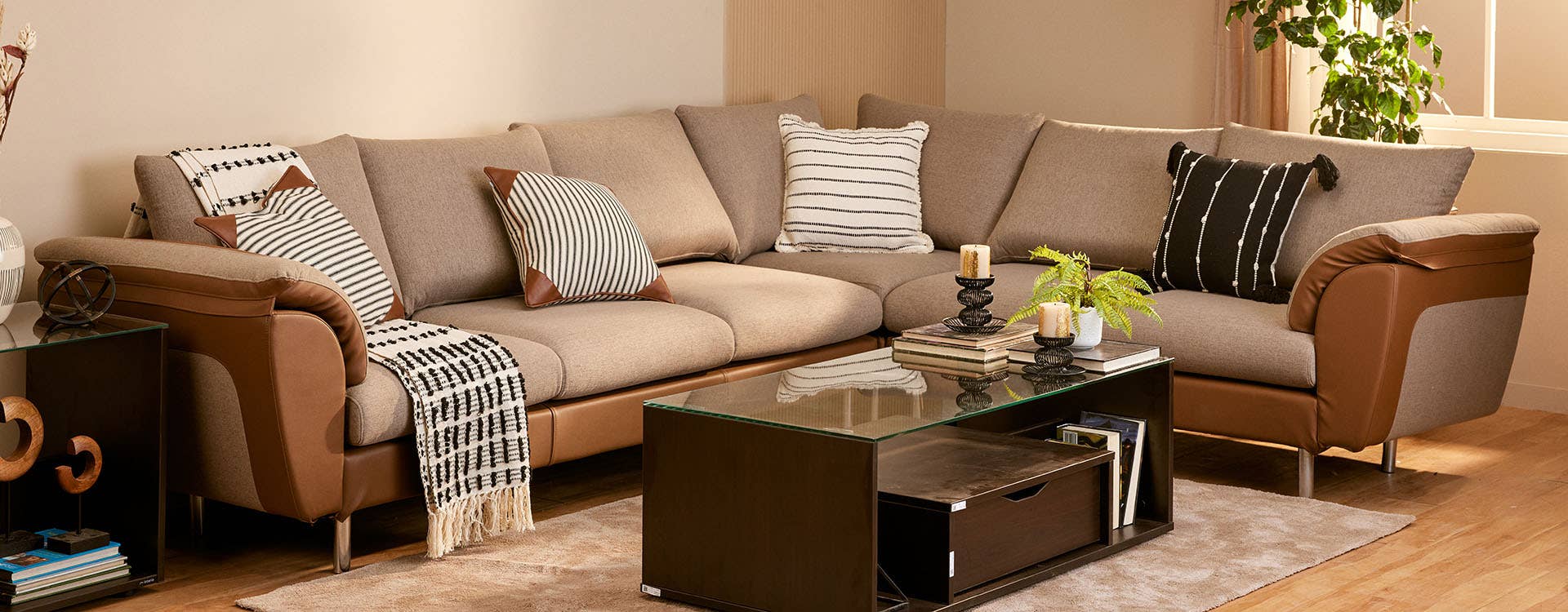
A coffee table can look right on its own and still feel wrong the moment it’s in the room: too large and you’re squeezing past it, too small and it disappears beside the sofa. Getting the size right is about how it relates to your sofa, your seating layout and the space you need to move through, not about the table alone. Here’s how to work out dimensions that suit your living room.
What Are Standard Coffee Table Dimensions (And Do They Exist)?
Most rectangular designs of coffee tables fall between 36 to 60 inches (91–152 cm) long and 18 to 30 inches (46–76 cm) wide. That being said, the right dimensions come down to the size and shape of your seating. Here’s a breakdown of what coffee table dimensions you can expect based on the type:
|
Coffee table type |
Typical length |
Typical width |
|
Compact |
30–36 in / 76–91 cm |
18–24 in / 46–61 cm |
|
Medium |
36–48 in / 91–122 cm |
20–28 in / 51–71 cm |
|
Large |
48–60 in / 122–152 cm |
24–30 in / 61–76 cm |
|
Oversized |
60+ in / 152+ cm |
28–36 in / 71–91 cm |
Treat these as starting points rather than fixed rules; your living room layout has the final say. A good coffee table earns its place beside the sofa without ever crowding the room around it.
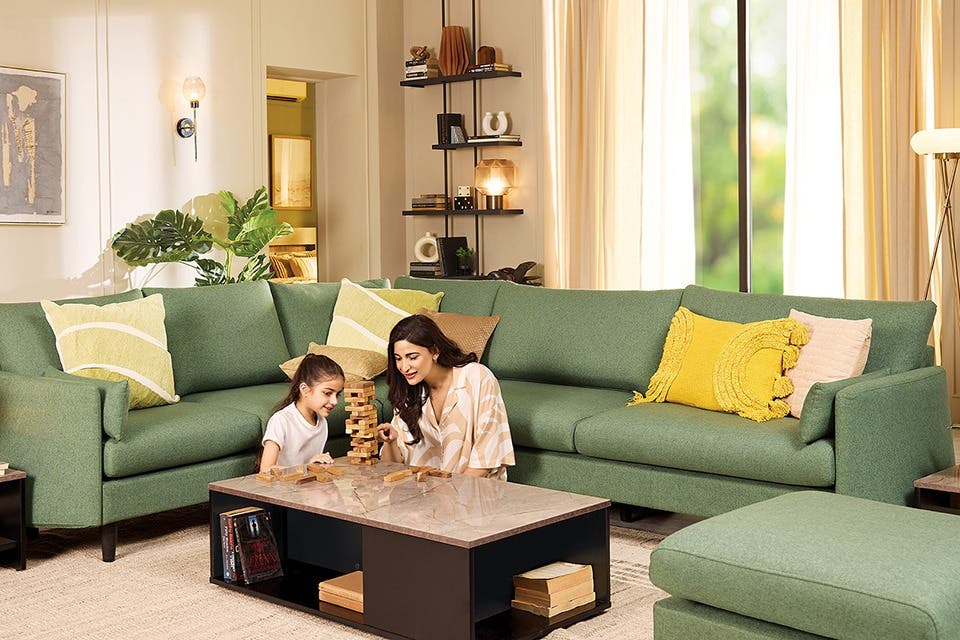 A coffee table should feel proportionate to the sofa it sits beside.
Let Your Sofa Set the Coffee Table Dimensions
Your sofa is usually the best reference point when choosing a coffee table. Aim for a table around two-thirds the length of the sofa; this creates visual balance and leaves space at either end.
|
Sofa length |
Suggested coffee table length |
|
60 in |
36–42 in |
|
72 in |
42–48 in |
|
84 in |
48–56 in |
|
96 in |
56–64 in |
These ranges are flexible; your table’s shape or seating arrangement can shift what works. For two facing sofas, a rectangular table usually sits naturally between them as a shared surface. For an L-shaped arrangement, a rectangular, oval or square table can all work depending on the floor area. If your seating is more flexible, nested tables let you add or remove surfaces as needed.
How High Should a Coffee Table Really Be?
Length and width are only half the equation; height is just as important for everyday comfort. Here, height means how far the tabletop sits from the floor, not the gap between table and sofa, which we’ll cover shortly.
For most living rooms, aim for a table roughly level with your sofa seat or slightly lower, typically 16 to 18 inches (41–46 cm). A lower table feels relaxed and contemporary, while a slightly taller one suits those who often eat or work from the sofa.
Get the height wrong and everyday use becomes awkward, too low means constant reaching down, too high makes the arrangement feel disconnected. The simplest test: sit on your sofa and reach for what you’d normally keep nearby. It should feel comfortably within reach.
Shape Matters Just as Much as Size
Rectangular tables are the most versatile choice, working well with long sofas and larger seating arrangements. They offer a generous surface without extra width, useful for a household that spreads out board games and laptops in equal measure.
Square tables suit large sectionals or rooms where seating wraps around several sides, drawing a group around one shared centre, though they need enough surrounding space to avoid feeling crowded.
Round tables soften a room full of straight lines, easing circulation, and work particularly well in compact spaces or homes with young children, where there are no sharp edges to worry about.
Oval tables combine the elongated surface of a rectangular design with softer edges, a good fit for medium and large rooms that want a gentler silhouette without losing surface space.
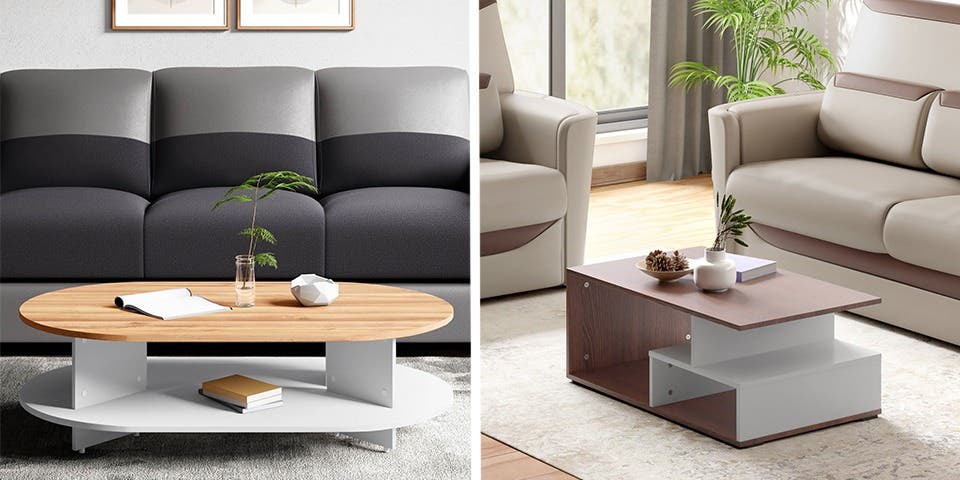 Shape does more than decide how a table looks, it shapes how people sit and talk around it.
Small Room, Big Room: Sizing the Space You Have
Floor area alone doesn’t decide the right coffee table measurements; the furniture already in the room plays just as big a role.
- In a small living room, a compact table, round shape or nested set keeps surface space useful without interrupting circulation.
- In a medium-sized room, a medium rectangular or oval table can anchor a standard sofa-and-chairs layout without dominating it.
- In a large living room, a small table can visually disappear, so consider a larger rectangular or square design, or even a pair of tables, to keep the seating pieces feeling like one arrangement rather than scattered furniture.
If you need extra storage or more room, look for a coffee table with expandable table tops or open shelving. This gives you more flexibility without adding more furniture to the room.
 A coffee table with removable tabletops gives you an easy workable surface.
Coffee Table Clearance: Room to Breathe
This is where many coffee table choices go wrong. The table might technically fit, but if there’s barely room to walk around it, everyday life gets harder than it needs to be.
As a general guide, leave around 14 to 16 inches (36–41 cm) of clearance between the coffee table and the sofa, enough to stretch your legs while keeping everything within reach. This is different from the table height covered earlier, it’s the gap between two pieces of furniture, not the height of one.
For main pathways, aim for roughly 30 to 36 inches (76–91 cm) of clear walking space. If someone needs to get from the sofa to the doorway, the coffee table shouldn’t be part of the obstacle course.
Five Minutes with a Tape Measure
Before buying, spend five minutes with a tape measure, it tells you far more than any product page, and it can save you from an expensive mistake.
- Measure your sofa. Record its overall length and depth; if you have a sectional, measure the whole configuration.
- Mark the footprint. Use masking tape on the floor to outline the size you’re considering, a far better sense of scale than any spec sheet.
- Check the clearance. Measure the distance from your outline to the sofa, other furniture, doorways and main walking paths.
- Check the height. Measure from the floor to the top of your sofa seat and use that as your guide for the table.
- Live with it. Leave the outline down for a day if you can, walk around it, sit on the sofa, reach towards it. If it feels intrusive, the table will too, and if it feels right, you’ll know before spending a rupee.
A Table That Does Its Quiet Work
Finding the right coffee table size starts with your sofa, not the table itself. Walk the room, check the clearances, and picture how you’ll use the space, reaching for a book, resting your feet, setting down a tray of chai for guests. Get the proportions right, and the table does its quiet work every day without you having to think about it again.